how long will a powered off ssd retain it’s data?
only that question. write endurance, fw failure, etc are out of scope. how to backup your data will not be covered here either.
beware those who claim to have the answer
how important is your data? is one article or forum post enough to convince you?
personal
do you trust this post? i don’t tend to get disks to not use them, these are the ones that i have as sample size.
anecdotal:
- samsung 840 pro had been powered off for 8 years without any data loss
- 3 pm1643 drives for 4 months without data loss
- 20 intel ssd dc s3510, no data loss after powered off just over a year
the samsung 840 was a surprise, did not expect it would be intact. the others were at or just over the time i would start worrying. that’s taking into account the conditions they operated in, how they were stored & the nand technology used. do not take this as gospel.
jedec
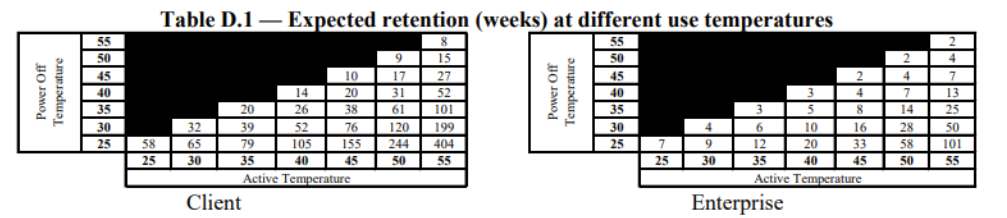
jedec’s jesd218c & jesd219 go into more detail on “retention use”, which boils down to:
- when active, run your drives hot
- when powered off, store your drives cool
the requirements set forth are:
- client ssd: 1 year data retention when stored at room temperature
- enterprise ssd: 3 months of data retention above room temperature.
the bigger the delta between hot/active & cold/powered off: the longer it takes before the loss occurs.
jesd218’s primary purpose is to provide a standardized testing procedure, it stresses that there are many factors that determine data retention - no single nor set of tests can cover all use cases the remark goes.
nand cell type
a personal addendum: while drives are powered on the background patrol will refresh a cell’s voltage when it goes outside a certain margin.
slc
with slc the concept is simple: reads above a certain voltage level are true (1), reads below are false(0)
mlc
with mlc you store 2 bits per cell, so you need (2^2=4) voltage levels to represent all possible values. possible voltage drops will have a more pronounced & negative impact. while powered on the disk’s background patrol will handle this, powered off it will retain data less long.
tlc
with tlc were are storing 3 bits per cell, so we’re now at (2^3=8) voltage levels to represent all possible values, and like mlc the error margin will become even smaller, again leading to a reduction in data retention.
publications by vendors
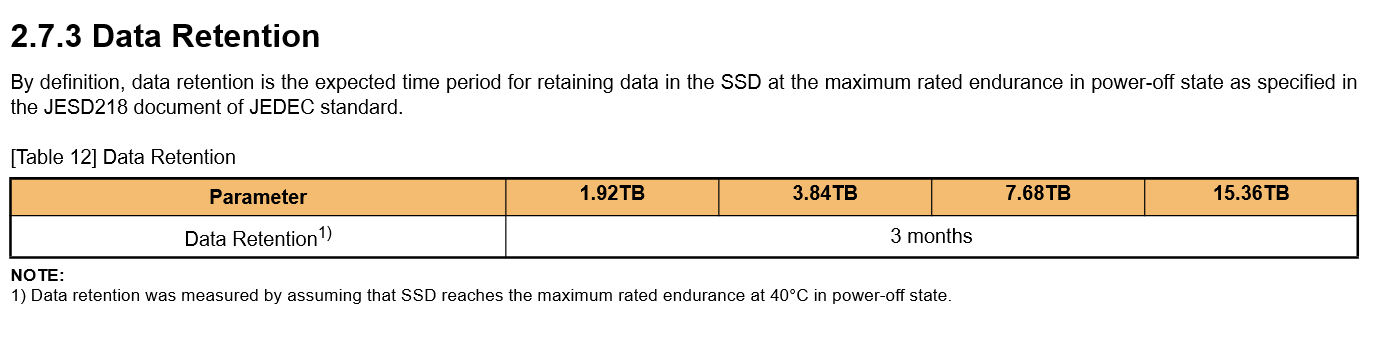
here are some extracts from data sheets, where enterprise class disks often mention the data retention period. for consumer class disks it’s seldom mentioned.
hitachi ultrastar sn100
2017 datasheet:

unnamed storage appliance vendor
2024 advisory:
unnamed ssd vendor
2018 datasheet:
 2023 sheet:
conclusion
while i have yet to experience data loss due to a disk being powered off over too long a period, it’s important to take note of what the vendors publish. having to mention a data retention period is not exactly good optics, neither is publishing an advisory on data loss when you’re a storage company.
i keep my ssd’s powered when possible.